Search is changing rapidly.
For years, Search Engine Optimization (SEO) was the primary strategy businesses used to improve their visibility on Google and other search engines. The objective was relatively straightforward: optimize a website so that its pages could appear higher in organic search results.
Today, the search ecosystem is much broader.
Users increasingly ask complete questions, expect direct answers, interact with conversational search systems, use AI-powered search experiences, and expect websites to provide fast and satisfying experiences once they arrive.
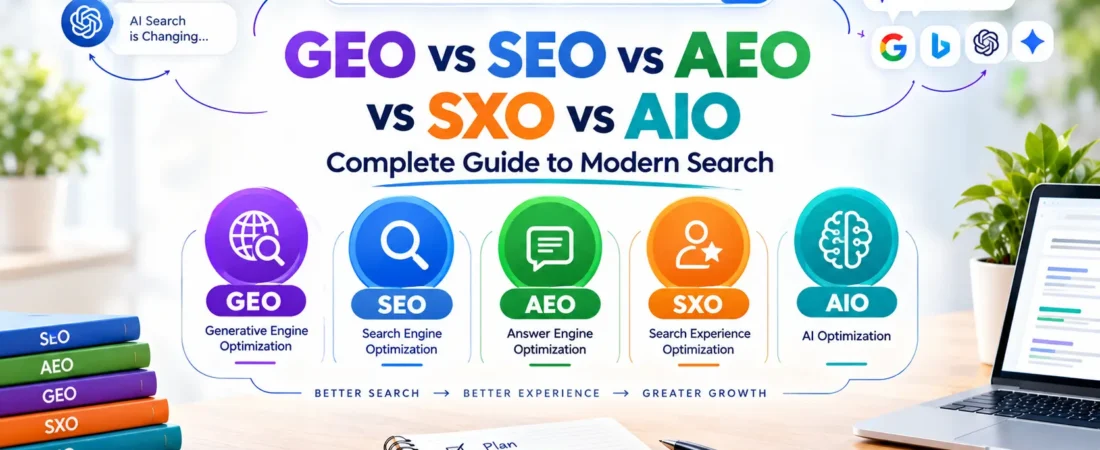
As a result, several terms have become increasingly important in digital marketing:
- SEO – Search Engine Optimization
- AEO – Answer Engine Optimization
- GEO – Generative Engine Optimization
- SXO – Search Experience Optimization
- AIO – AI Optimization
These terms can sound confusing because they overlap considerably.
Is GEO replacing SEO?
Is AEO the same as GEO?
What does SXO have to do with user experience?
Is AIO simply another name for optimizing content for AI?
The answer is more nuanced.
These approaches focus on different aspects of visibility, answers, AI-generated results, search experience, and optimization. Rather than treating them as five completely separate marketing strategies, it is more useful to understand how they can work together.
This guide explains GEO vs SEO vs AEO vs SXO vs AIO, including their definitions, objectives, differences, similarities, examples, practical applications, and how you can combine them into one modern search strategy.
Quick Comparison: GEO vs SEO vs AEO vs SXO vs AIO
Before going into detail, here is a simplified comparison:
| Approach | Full Form | Primary Focus | Main Goal |
|---|---|---|---|
| SEO | Search Engine Optimization | Search engines and organic rankings | Improve visibility in traditional search |
| AEO | Answer Engine Optimization | Direct answers and answer-focused search | Increase chances of being used as an answer |
| GEO | Generative Engine Optimization | Generative AI search experiences | Improve visibility and representation in AI-generated responses |
| SXO | Search Experience Optimization | Searcher journey and experience | Improve the experience from search to website conversion |
| AIO | AI Optimization | AI systems and AI-driven discovery | Make content and brand information easier for AI systems to understand and use |
These definitions can overlap, and terminology is not standardized across the entire SEO industry. Different marketers and platforms sometimes use these acronyms differently.
The important point is to understand the optimization objective, rather than focusing only on the label.
What Is SEO?
SEO stands for Search Engine Optimization.
SEO is the process of improving a website and its content so that search engines can discover, understand, index, and potentially rank its pages for relevant searches.
Traditional SEO typically covers areas such as:
- Keyword research
- Search intent
- Technical SEO
- On-page SEO
- Content optimization
- Internal linking
- Website architecture
- Mobile optimization
- Page performance
- Structured data
- Link earning
- Local SEO
- Ecommerce SEO
- Search performance analysis
The ultimate objective is to increase relevant organic visibility and traffic.
How SEO Works
Imagine someone searches:
How to improve organic traffic to a new website?
A traditional SEO strategy would involve creating a page that:
- Understands the search intent
- Clearly addresses the question
- Uses relevant terminology
- Has a strong page structure
- Is technically accessible
- Can be crawled and indexed
- Provides a good user experience
- Demonstrates useful expertise
- Is supported by appropriate internal links
- Builds authority over time
The result may appear in traditional organic search results.
Key Components of SEO
1. Technical SEO
Technical SEO helps search engines access and understand your website.
It includes:
- Crawling
- Indexing
- XML sitemaps
- Robots.txt
- Canonical URLs
- Redirects
- HTTPS
- Mobile usability
- Website architecture
- Page performance
2. On-Page SEO
On-page SEO focuses on individual pages.
Important elements include:
- Title tags
- Headings
- URLs
- Content
- Internal links
- Images
- Alt text
- Metadata
- Search intent
3. Content SEO
Content should answer the questions and problems your target audience has.
Modern content SEO is less about repeating a keyword and more about:
Topic + intent + usefulness + expertise + clarity
4. Off-Page SEO
Off-page SEO involves activities outside your website that can contribute to authority and visibility.
Examples include:
- Relevant backlinks
- Digital PR
- Brand mentions
- Industry relationships
- Business listings
- Content promotion
What Is AEO?
AEO stands for Answer Engine Optimization.
AEO focuses on optimizing content so that it can provide clear answers to questions asked through search engines, voice assistants, answer engines, and other answer-focused interfaces.
Instead of thinking only about:
How can my page rank?
AEO asks:
How can my content provide the clearest and most useful answer to the user’s question?
How AEO Differs From Traditional SEO
Traditional SEO often focuses heavily on page visibility and rankings.
AEO places greater emphasis on answer extraction and answer satisfaction.
For example, suppose someone searches:
What is a canonical tag?
A page optimized for AEO might begin with a concise definition:
A canonical tag is an HTML element that indicates the preferred version of a page when multiple URLs contain similar or duplicate content.
The explanation can then expand with examples and implementation guidance.
This structure helps users find the answer quickly while still providing comprehensive information.
Important AEO Techniques
Use Question-Based Headings
Instead of only writing:
Canonical Tags
you could use:
What Is a Canonical Tag?
This makes the question and answer relationship explicit.
Answer Questions Directly
Don’t hide the main answer underneath several paragraphs of introduction.
Provide the essential answer early and then expand.
Use Structured Content
Useful formats include:
- Definitions
- Lists
- Steps
- Tables
- Comparisons
- FAQs
- Examples
These formats can make information easier to understand and process.
Cover Related Questions
A user asking one question may have several follow-up questions.
For example:
What is keyword difficulty?
Related questions could include:
- How is keyword difficulty calculated?
- What is a good keyword difficulty?
- Is keyword difficulty reliable?
- Can a new website rank for difficult keywords?
Covering these related questions creates a more complete resource.
What Is GEO?
GEO commonly stands for Generative Engine Optimization.
GEO focuses on improving the likelihood that a website, brand, content, expertise, or information is represented appropriately within generative AI-powered search and answer experiences.
Instead of focusing exclusively on traditional search-result rankings, GEO considers how information may be discovered, interpreted, summarized, referenced, or represented by generative systems.
Why GEO Has Become Important
Search behavior is expanding beyond traditional lists of blue links.
Users may now ask conversational questions and expect synthesized responses.
For example:
What are the most important SEO strategies for a new website?
A generative search system may synthesize information from multiple sources to produce a response.
This creates a new visibility question:
Can my website’s information become useful source material for the answer?
GEO attempts to address this broader environment.
How GEO Differs From SEO
SEO primarily focuses on improving organic search visibility.
GEO focuses more specifically on visibility and representation within generative search experiences.
However, there is substantial overlap.
A website with:
- Strong content
- Good technical SEO
- Clear information
- Demonstrated expertise
- Relevant authority
- Well-organized pages
- Strong topical coverage
can potentially be better positioned for both traditional search and AI-powered discovery.
Therefore:
GEO should generally complement SEO rather than be treated as a replacement for it.
GEO Strategies
1. Provide Clear, Factual Information
Generative systems need information that can be understood and interpreted.
Avoid vague statements.
Explain:
- What something is
- How it works
- Why it matters
- When to use it
- Examples
- Limitations
2. Build Topical Authority
Instead of publishing one article about SEO, create a connected ecosystem.
For example:
- Technical SEO
- Keyword research
- On-page SEO
- Content strategy
- Internal linking
- SEO audits
- Local SEO
- Ecommerce SEO
- AI search
- AEO
- GEO
Connect relevant articles using internal links.
3. Demonstrate First-Hand Experience
Generic information is everywhere.
Original experience can make your content more distinctive.
Include:
- Case studies
- Experiments
- Examples
- Screenshots
- Original observations
- Processes
- Lessons learned
- Data where available
For your own website, for example, you could document how you implemented SEO changes and what you learned from the results.
4. Make Important Information Easy to Find
Avoid hiding important information behind complicated navigation.
Use:
- Descriptive headings
- Clear paragraphs
- Tables
- Lists
- Definitions
- FAQs
- Logical page structure
5. Strengthen Brand and Entity Signals
AI systems may need to understand not only individual pages but also the entities and relationships associated with a website.
Clearly communicate:
- Who you are
- What your organization does
- Areas of expertise
- Services
- Authors
- Contact information
- Professional background
What Is SXO?
SXO stands for Search Experience Optimization.
SXO combines search optimization with user experience.
The idea is simple:
Getting someone to click your search result is not the end of SEO. It is the beginning of the user’s experience.
Imagine your page ranks well for an important keyword.
A visitor clicks your result.
But then:
- The page loads slowly
- The content is difficult to read
- Pop-ups cover the screen
- Navigation is confusing
- The answer is buried
- The page doesn’t match the search intent
- There is no clear next step
The ranking may generate a visit, but the overall experience is poor.
SXO looks at the journey from search query to user satisfaction and action.
Key Components of SXO
Search Intent
Understand what the visitor expects.
Search Snippet
Create useful titles and descriptions that accurately represent the page.
Landing Page Experience
Make sure the page delivers what the search result promised.
Navigation
Help users find additional relevant information.
Readability
Use:
- Short paragraphs
- Headings
- Lists
- Visuals
- Tables
Performance
A slow website can create friction.
Conversion Experience
If the page is commercial, provide a logical next step.
Examples:
- Contact us
- Request consultation
- Download guide
- Buy product
- Register
- Subscribe
What Is AIO?
AIO can mean different things depending on the context.
In modern digital marketing discussions, AIO is often used to refer broadly to AI Optimization or optimization for AI-driven discovery and systems.
However, unlike SEO, AEO, and GEO, the acronym AIO is not consistently standardized across the industry.
Some organizations use AIO to describe optimizing content and digital assets for AI systems.
Others may use AIO to refer to different concepts.
Therefore, when using the term professionally, it is useful to define what you mean by AIO.
For this guide, we use:
AIO = AI Optimization: making a website, content, brand information, and digital assets easier for AI systems to understand, interpret, retrieve, and potentially represent.
What Does AI Optimization Include?
AIO can involve:
- Structuring information clearly
- Improving entity understanding
- Providing authoritative content
- Using structured data appropriately
- Maintaining consistent business information
- Creating comprehensive topic coverage
- Demonstrating expertise
- Publishing original information
- Making important facts easy to identify
- Optimizing digital content for AI-mediated discovery
In this sense, AIO can be considered a broader umbrella around AI-related optimization activities.
GEO vs SEO
Let’s compare them directly.
| SEO | GEO |
|---|---|
| Focuses heavily on search engine visibility | Focuses on generative search visibility |
| Traditional organic results are important | AI-generated responses are important |
| Rankings are a major measurement | Mentions, citations, representation and visibility can be relevant |
| Keyword research remains useful | Topic/entity understanding becomes increasingly important |
| Technical SEO is foundational | Technical accessibility remains foundational |
| Links and authority matter | Authority and trustworthy information remain important |
| Search intent is essential | User questions and conversational intent are important |
The two approaches overlap significantly.
A strong technical and content foundation can support both.
GEO vs AEO
GEO and AEO are closely related but emphasize different things.
| AEO | GEO |
|---|---|
| Focuses on answering questions | Focuses on generative AI experiences |
| Direct answers are important | Synthesized responses are important |
| Question-answer structures are useful | Comprehensive information can be important |
| Featured-answer style visibility may be relevant | AI-generated representation may be relevant |
| Concise answers can be valuable | Context and supporting information can be valuable |
AEO can be thought of as strongly answer-oriented.
GEO is more focused on generative search environments.
There is considerable overlap between them.
SEO vs AEO
SEO and AEO should not be viewed as competing strategies.
Traditional SEO helps a search engine discover and understand your content.
AEO focuses more specifically on making the content useful for answer-oriented queries.
For example, a page can use SEO fundamentals while also containing:
- A direct definition
- Question-based headings
- Concise answers
- Supporting examples
- FAQs
This gives the same page multiple opportunities to satisfy search behavior.
SEO vs SXO
SEO can bring visitors to your website.
SXO asks what happens after they arrive.
Consider this journey:
Search → Search Result → Click → Landing Page → Engagement → Action
SEO influences the visibility stage.
SXO considers the broader journey.
Therefore, SEO and SXO work particularly well together.
GEO vs SXO
GEO focuses on visibility and representation within generative search environments.
SXO focuses on the experience once users interact with your search presence and website.
A strong strategy can therefore look like:
GEO → Discovery → Click/Visit → SXO → Engagement → Conversion
The exact user journey varies depending on the search experience and website.
AEO vs SXO
AEO helps answer the user’s question.
SXO helps ensure that the user’s overall experience is useful and satisfying.
For example:
AEO:
Provide a clear answer to “What is a 301 redirect?”
SXO:
Make the page easy to read, fast to load, easy to navigate, and useful enough for the visitor to continue exploring.
Together, they create a stronger user journey.
AIO vs GEO
These terms are often used interchangeably in casual discussions, but they can represent different scopes.
GEO is usually more specifically associated with generative search or generative engines.
AIO, when used as AI Optimization, can describe a broader effort to make digital information understandable and useful to AI systems.
Therefore:
GEO can be viewed as one part of a broader AI-oriented optimization strategy.
This interpretation depends on how the organization defines AIO.
SEO + AEO + GEO + SXO + AIO: The Modern Search Framework
Instead of choosing one, consider combining the principles.
A useful framework is:
SEO
Make the website technically accessible and discoverable.
↓
AEO
Answer important questions clearly.
↓
GEO
Create authoritative information that can be useful within generative search experiences.
↓
SXO
Provide an excellent experience from search result to website interaction.
↓
AIO
Ensure your broader digital information is structured and understandable for AI-driven discovery.
This creates a more comprehensive search strategy.
Example: Optimizing One Blog Article Using All Five Approaches
Suppose you publish an article:
How to Get Organic Traffic to a New Website
You could apply the five approaches as follows.
SEO
Optimize:
- URL
- Title
- H1
- Headings
- Keywords
- Internal links
- Images
- Technical accessibility
- Mobile experience
- Page speed
AEO
Add questions such as:
How long does it take to get organic traffic?
Provide a direct answer followed by supporting detail.
GEO
Strengthen the article with:
- Original observations
- Practical examples
- Clear definitions
- Relevant data
- Author expertise
- Comprehensive topic coverage
SXO
Improve:
- Readability
- Page layout
- Navigation
- Content hierarchy
- Mobile experience
- Calls to action
AIO
Make the information:
- Clearly structured
- Entity-aware
- Consistent
- Well documented
- Easy to interpret
- Supported by appropriate structured data
The same article can therefore serve multiple search environments.
Which Is More Important: SEO, GEO, AEO, SXO or AIO?
There isn’t a universal answer.
They solve different problems.
If your website has serious technical problems, start with SEO fundamentals.
If users frequently ask questions related to your topic, strengthen AEO-style content.
If your goal includes visibility in generative search environments, incorporate GEO principles.
If visitors reach your site but don’t engage or convert, improve SXO.
If your broader goal is making your digital information understandable across AI-driven systems, consider the broader principles associated with AIO.
For most websites, these are not mutually exclusive choices.
A Practical Strategy for a New Website
For a new website, don’t try to implement every advanced concept simultaneously.
Start with the fundamentals.
Phase 1: Technical Foundation
Focus on:
- HTTPS
- Crawlability
- Indexing
- Sitemap
- Robots.txt
- Mobile usability
- Website architecture
- Page performance
This is your SEO foundation.
Phase 2: Keyword and Intent Research
Identify:
- Main topics
- Long-tail searches
- Questions
- Commercial queries
- Search intent
- Content gaps
Phase 3: Create Helpful Content
Develop:
- Pillar pages
- Supporting articles
- FAQs
- Tutorials
- Comparisons
- Case studies
Make the information genuinely useful.
Phase 4: Add AEO Elements
Use:
- Question headings
- Direct answers
- Definitions
- Lists
- Tables
- FAQs
Phase 5: Strengthen GEO Signals
Add:
- First-hand experience
- Original research
- Author information
- Relevant expertise
- Clear entity information
- Useful citations/references where appropriate
- Comprehensive topic coverage
Phase 6: Improve SXO
Analyze:
- Click-through rates
- Landing-page behavior
- Engagement
- Navigation
- Conversion paths
- Mobile usability
Phase 7: Develop AI-Oriented Optimization
Make important information:
- Consistent
- Structured
- Accessible
- Accurate
- Easy to interpret
Continue building your overall digital presence rather than optimizing only individual pages.
How to Measure Each Strategy
Measurement is important because optimization should be connected to outcomes.
| Strategy | Useful Areas to Monitor |
|---|---|
| SEO | Organic impressions, clicks, rankings, indexed pages, organic conversions |
| AEO | Visibility for question-based searches and answer-oriented search features |
| GEO | AI-search visibility, mentions/citations where measurable, referral traffic where available |
| SXO | Engagement, landing-page performance, conversions, user journey |
| AIO | AI-driven discovery and representation where measurable |
There is currently no single universal analytics dashboard that can perfectly measure every aspect of AI search visibility.
Therefore, combine available search, analytics, referral, brand, and content data.
Common Mistakes When Implementing Modern Search Optimization
Mistake 1: Treating GEO as a replacement for SEO
Technical SEO and website accessibility remain foundational.
Mistake 2: Writing content only for AI systems
Your primary audience is still people.
Create content that is useful to humans first.
Mistake 3: Stuffing keywords everywhere
Modern optimization is not about repeating the same phrase.
Focus on meaning, intent, entities, topics, and usefulness.
Mistake 4: Creating hundreds of low-value AI articles
Publishing more content does not automatically create authority.
Quality and originality matter.
Mistake 5: Ignoring user experience
A search visitor is not simply a traffic number.
They are a potential customer, reader, subscriber, or returning visitor.
Mistake 6: Chasing every new acronym
SEO terminology will continue to evolve.
Don’t rebuild your entire strategy every time a new acronym becomes popular.
Focus on fundamental principles:
Discoverability + Relevance + Usefulness + Trust + Experience
The Future of Search Optimization
The boundaries between search engines, answer engines, generative AI, and websites are becoming less distinct.
Users may discover information through:
- Traditional search results
- AI-generated summaries
- Conversational assistants
- Voice interfaces
- Social platforms
- Video platforms
- Forums
- Brand websites
- Online communities
This means digital visibility is becoming increasingly distributed.
A modern SEO strategy therefore needs to consider not only:
Where does my page rank?
but also:
How easily can people and information systems discover, understand, trust, and use my information?
That is a much broader question.
The Modern Search Optimization Pyramid
A practical way to think about the relationship is:
Level 1 — SEO Foundation
Make your website technically accessible.
Level 2 — Content & Intent
Create useful content that satisfies real searches.
Level 3 — AEO
Answer questions clearly and directly.
Level 4 — GEO
Strengthen visibility and representation within generative search experiences.
Level 5 — SXO
Improve the complete search-to-website experience.
Level 6 — AI Optimization
Build an information ecosystem that is clear and understandable for AI-driven discovery.
These layers should reinforce each other rather than operate independently.
Frequently Asked Questions
What is the difference between SEO and GEO?
SEO primarily focuses on improving visibility in traditional search engines and organic results. GEO focuses more specifically on visibility and representation within generative AI-powered search experiences. The two overlap significantly and can be used together.
Is GEO replacing SEO?
No. GEO should generally be considered complementary to SEO. Technical accessibility, content quality, relevance, search intent, and website authority remain important foundations for online visibility.
What is the difference between AEO and GEO?
AEO focuses on optimizing content to provide clear answers to questions. GEO focuses more broadly on generative search experiences where AI systems may synthesize information from multiple sources.
What is SXO in digital marketing?
SXO means Search Experience Optimization. It combines search visibility with the user’s experience from the search result through the website visit and, where relevant, conversion.
What does AIO mean in SEO?
AIO can refer to AI Optimization in some digital marketing contexts, although the acronym is not standardized. When used this way, it describes efforts to make digital information easier for AI systems to understand, retrieve, interpret, and represent.
Should I focus on SEO or GEO?
For most websites, the two should not be treated as an either/or decision. Build a strong SEO foundation and incorporate useful practices for answer-oriented and generative search experiences.
Can one article be optimized for SEO, AEO and GEO?
Yes. A well-structured article can target traditional organic search while also providing direct answers, comprehensive context, original insights, and clear information that may be useful in AI-powered search environments.
Does structured data help with GEO?
Structured data can help search engines understand eligible information on a page, but it should not be treated as a guarantee of visibility in generative AI results. Use structured data accurately and according to applicable guidelines.
Is SXO the same as UX?
SXO and UX overlap, but SXO specifically connects user experience with the search journey. It considers how people discover a page through search, interact with the result, experience the landing page, and move toward their intended goal.
Which strategy is best for a new website?
A new website should first establish strong technical SEO, clear information architecture, relevant keyword targeting, useful content, and good user experience. AEO, GEO, and broader AI-oriented optimization can then be integrated into the same foundation.
Final Takeaway
SEO, AEO, GEO, SXO, and AIO are not necessarily five competing versions of the same strategy.
They emphasize different parts of the modern discovery and search experience:
SEO helps search engines discover and rank relevant content.
AEO focuses on providing clear answers to user questions.
GEO focuses on visibility and representation in generative search experiences.
SXO focuses on the experience users have from search to website interaction.
AIO, when used to mean AI Optimization, takes a broader view of making digital information understandable and useful to AI systems.
The most practical approach is therefore not to abandon SEO whenever a new acronym appears.
Instead, build a strong foundation and expand it.
Optimize for search engines. Answer users clearly. Create information AI systems can understand. Build trust and authority. Improve the search experience. And above all, create genuinely useful content for people.